Fort Richardson in Jacksboro, Tx will have a Civil War event on September 10-12 which is sponsored by Hosted by Key's Battery and 13th Texas Calvary. More information is available at http://www.keysbattery.com/battleforfortrichardson/
.
Monday, August 23, 2010

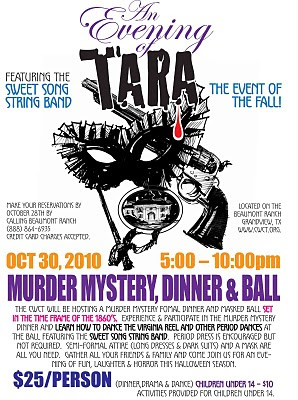
New Event -- Murder Mystery Period Masked Ball-- October 30, 2010
On October 30, 2010 at Beaumont Ranch in Grandview, TX the Civil War Center of Texas is having a Murder Mystery Dinner and Ball at which our favorite band, the Sweet Song String Band is playing. Below is a flyer for the dance which sounds like it will be great fun. Click on the picture to enlarge the information or go to http://www.cwct.org/ for more information.

Monday, July 12, 2010
Ft. Concho’s National Cavalry Competition event -- help needed
The Frontier Women’s Living History Assn. will be helping at Ft. Concho’s National Cavalry Competition event, Sept. 30 - Oct. 3, 2010 with activities for women and civilians who accompany the competitors and perhaps the public. We need ideas and volunteers. Please send me any ideas you might have and let me know if you will be at Ft. Concho for the event. It sounds like there will be about 50 people who might be interested in our activities. Below I have listed some ideas that have already been suggested as a jumping off place for your great additions. Your help is greatly appreciated. Check the blog for updates http://www.frontierwomen.blogspot.com/
Ann Dixon
http://www.fortconcho.com/events.htm
http://www.uscavalry.org/
Possible activities:
1. Afternoon tea
a. Suggestions for music or activities
2. Period craft workshop
a. Easy period crafts suggestions
b. Volunteers to teach crafts
c. Materials
3. Trolley trip to Concho Street Antique District
4. History type presentation
a. Suggestions for topic
b. Volunteers
5. Living History volunteers for staffing Officer’s quarters open to the public
6. Ladies bazaar similar to the March conference – open only a couple hours with invitations to incoming participants if they wish to bring things to sale or trade.
Ann Dixon
http://www.fortconcho.com/events.htm
http://www.uscavalry.org/
Possible activities:
1. Afternoon tea
a. Suggestions for music or activities
2. Period craft workshop
a. Easy period crafts suggestions
b. Volunteers to teach crafts
c. Materials
3. Trolley trip to Concho Street Antique District
4. History type presentation
a. Suggestions for topic
b. Volunteers
5. Living History volunteers for staffing Officer’s quarters open to the public
6. Ladies bazaar similar to the March conference – open only a couple hours with invitations to incoming participants if they wish to bring things to sale or trade.
Saturday, July 10, 2010
Workshop in Alamagordo
I received this notice of a workshop that I thought many of you would be interested in.
Dear Ladies:
I have attached a flyer with a description of two workshops we are offering in Alamogordo on Sat., and Sunday, August 21 and 22. We have scheduled it so that anyone coming from out-of-town can drive down Sat. a.m., and leave after lunch on Sunday. Saturday's workshop begins at 12:30, with a break at 2:30 for tea, and then resumes until 5:30. Sunday's workshop is from 9:00 to 1:00.
I hope I will see some of you here that weekend. I think this is a great opportunity for us to expand our knowledge and skills as re-enactors and interpreters of the past.
Please email me as soon as possible if you plan to come, so we will be able to accomodate everyone. Space is very limited! Check out anna's blog http://annaworden.wordpress.com/ for information about her, and put this workshop on your calendar.
Sincerely,
Victoria Davis
Workshops in Alamogordo!!!
Bodice Draping Workshop Saturday, Aug. 24 at 12:00
Learn to drape your own bodice toile and make your own pattern.
Learn about seam placement for the mid-19th century.
Find ways to get the best fit for your body shape.
Please bring: Chemise, Corset or Stays, and Sewing kit including scissors, pen/pencil, measuring tape, string, pins
Favorite pattern making paper (I love wrapping paper)
Cost: $20.00
Includes: Muslin for draping and workshop handouts
Hairnet Workshop Sunday, Aug. 25 morning
Learn about hairnets appropriate to the mid-19th century.
Embellish a net with ribbon.
Please bring:
Silk ribbons if you have them (3/4"-1 1/2" wide, not bias cut or hand-dyed), sewing kit including pins, needles and coordinating threads.
Cost: $7.00 ($12.00 if you need ribbon)
Includes: Net to embellish and workshop handouts.
Special - Combine both workshops for $25.00
($30 if you need ribbon)
Dear Ladies:
I have attached a flyer with a description of two workshops we are offering in Alamogordo on Sat., and Sunday, August 21 and 22. We have scheduled it so that anyone coming from out-of-town can drive down Sat. a.m., and leave after lunch on Sunday. Saturday's workshop begins at 12:30, with a break at 2:30 for tea, and then resumes until 5:30. Sunday's workshop is from 9:00 to 1:00.
I hope I will see some of you here that weekend. I think this is a great opportunity for us to expand our knowledge and skills as re-enactors and interpreters of the past.
Please email me as soon as possible if you plan to come, so we will be able to accomodate everyone. Space is very limited! Check out anna's blog http://annaworden.wordpress.com/ for information about her, and put this workshop on your calendar.
Sincerely,
Victoria Davis
Workshops in Alamogordo!!!
Bodice Draping Workshop Saturday, Aug. 24 at 12:00
Learn to drape your own bodice toile and make your own pattern.
Learn about seam placement for the mid-19th century.
Find ways to get the best fit for your body shape.
Please bring: Chemise, Corset or Stays, and Sewing kit including scissors, pen/pencil, measuring tape, string, pins
Favorite pattern making paper (I love wrapping paper)
Cost: $20.00
Includes: Muslin for draping and workshop handouts
Hairnet Workshop Sunday, Aug. 25 morning
Learn about hairnets appropriate to the mid-19th century.
Embellish a net with ribbon.
Please bring:
Silk ribbons if you have them (3/4"-1 1/2" wide, not bias cut or hand-dyed), sewing kit including pins, needles and coordinating threads.
Cost: $7.00 ($12.00 if you need ribbon)
Includes: Net to embellish and workshop handouts.
Special - Combine both workshops for $25.00
($30 if you need ribbon)
Unique Crochet thimble holder
From Bev:
 Here is an interesting crochet thimble holder using a chicken wishbone.
Here is one on Etsy:
http://www.etsy.com/listing/32766349/thimble-holder-crocheted-around-a
And another one:
http://www.rubylane.com/item/538537-M0571/Folky-Hand-Crocheted-WISHBONE-Thimble


Here is one on Etsy:
http://www.etsy.com/listing/32766349/thimble-holder-crocheted-around-a
And another one:
http://www.rubylane.com/item/538537-M0571/Folky-Hand-Crocheted-WISHBONE-Thimble
Wednesday, June 9, 2010
History of Crochet
This information was gleaned from CQembellishers@yahoogroups.com and http://www.iainabrach.org/BlogItem.asp?ID=6and forwarded by Bev for our information.
The modern needlework technique, crochet, stems from an embroidery technique
called Tambour Work or Tambour Embroidery. Tambour Embroidery was widely
used to create a single, continuous chain stitch on either a piece of fabric
or a net ground, depending on the time period. Early samples of Tambour Work
are dated to the fourteenth century in liturgical textiles almost
exclusively. This work was executed by nuns and was also referred to as
Nun's Work.
One of the many symbols of freedom that came out of the French Revolution
was Crocheted Lace. Since the people were free from the foundation and
restraints of the old government, lace making became a statement of being
freed from the old ways of manufacture. The word "frivolitaire" was used to
describe crochet and this new technique was categorized under "Punto en
Aria", literally "stitch made in the air".
Crochet is worked without a foundation pattern. Soon ladies of quality and
leisure were crocheting everywhere as a sign of their freedom from tyranny.
The novelty of crocheted lace did wear off and the market was restored for
bobbin and needle made laces. Thus crochet fell out of favor until the Great
Potato Famine struck Ireland in the mid nineteenth century. In an effort to
bolster the Irish economy as well as help feed the thousands of starving
Irish, crocheted lace was introduced to the Irish poorer classes by nuns and
charitable English women. Queen Victoria did her part by making Irish
Crocheted Lace popular in english society as well as throughout the
continent.
With the onset of the twentieth century, lady's magazines published patterns
for many types of homemade crafts and crocheted lace continued.
It should be noted that up to this point in history, all crochet was done
with fine cotton or linen thread, not yarn. Knitting was still the method of
choice for working with wool, so socks, sweaters, comforters were still
knitted. The bulky yarns and super sized hooks which are much used today
came along during the post World War Two era and reached a heyday in the
1960's with the various back-to-nature movements. Because heavy yarns and
large hooks worked up much faster than the fine steel hooks manipulating
fine thread, the Jiffy Crochet gained favor. A person could quickly turn out
a handmade article without putting too much time into the work.
http://www.iainabrach.org/BlogItem.asp?ID=6
Chain stitch is also known as tambour stitch and point de chainette. Chain
stitch is one of the oldest of the decorative stitches and is the basis of a
large group of stitches.
-------------
Tambour embroidery, introduced to the Western world by France, is a
continuous worked chain stitch formed with a tambour hook, which forms a
loop similar to a crochet chain. The stitch is formed on the fabric with the
thread held underneath in one hand while the other hand inserts the hook
down through the fabric to catch the thread. The needle is brought back
through the same hole, forming a loop. The following stitches are formed a
short distance from the previous stitch, catching the loop of the last
stitch at the beginning of the next.
The Chinese introduced this embroidery technique to the French during the
later part of the 18th century. The French term "tambour: (meaning) a drum"
best described the technique that required the ground fabric to be first
stretched taught in a frame before the stitching was begun. The embroidery
yarns used for a tambour stitch could be: a single strands of floss, twisted
silk, metal or fine silk chenille threads. Even though the stitch itself was
simple, the elegant yarns coupled with the intricate shading and elaborate
designs tended to create extraordinary thread painted works of art.
--------------
The modern needlework technique, crochet, stems from an embroidery technique
called Tambour Work or Tambour Embroidery. Tambour Embroidery was widely
used to create a single, continuous chain stitch on either a piece of fabric
or a net ground, depending on the time period. Early samples of Tambour Work
are dated to the fourteenth century in liturgical textiles almost
exclusively. This work was executed by nuns and was also referred to as
Nun's Work.
One of the many symbols of freedom that came out of the French Revolution
was Crocheted Lace. Since the people were free from the foundation and
restraints of the old government, lace making became a statement of being
freed from the old ways of manufacture. The word "frivolitaire" was used to
describe crochet and this new technique was categorized under "Punto en
Aria", literally "stitch made in the air".
Crochet is worked without a foundation pattern. Soon ladies of quality and
leisure were crocheting everywhere as a sign of their freedom from tyranny.
The novelty of crocheted lace did wear off and the market was restored for
bobbin and needle made laces. Thus crochet fell out of favor until the Great
Potato Famine struck Ireland in the mid nineteenth century. In an effort to
bolster the Irish economy as well as help feed the thousands of starving
Irish, crocheted lace was introduced to the Irish poorer classes by nuns and
charitable English women. Queen Victoria did her part by making Irish
Crocheted Lace popular in english society as well as throughout the
continent.
With the onset of the twentieth century, lady's magazines published patterns
for many types of homemade crafts and crocheted lace continued.
It should be noted that up to this point in history, all crochet was done
with fine cotton or linen thread, not yarn. Knitting was still the method of
choice for working with wool, so socks, sweaters, comforters were still
knitted. The bulky yarns and super sized hooks which are much used today
came along during the post World War Two era and reached a heyday in the
1960's with the various back-to-nature movements. Because heavy yarns and
large hooks worked up much faster than the fine steel hooks manipulating
fine thread, the Jiffy Crochet gained favor. A person could quickly turn out
a handmade article without putting too much time into the work.
http://www.iainabrach.org/BlogItem.asp?ID=6
Chain stitch is also known as tambour stitch and point de chainette. Chain
stitch is one of the oldest of the decorative stitches and is the basis of a
large group of stitches.
-------------
Tambour embroidery, introduced to the Western world by France, is a
continuous worked chain stitch formed with a tambour hook, which forms a
loop similar to a crochet chain. The stitch is formed on the fabric with the
thread held underneath in one hand while the other hand inserts the hook
down through the fabric to catch the thread. The needle is brought back
through the same hole, forming a loop. The following stitches are formed a
short distance from the previous stitch, catching the loop of the last
stitch at the beginning of the next.
The Chinese introduced this embroidery technique to the French during the
later part of the 18th century. The French term "tambour: (meaning) a drum"
best described the technique that required the ground fabric to be first
stretched taught in a frame before the stitching was begun. The embroidery
yarns used for a tambour stitch could be: a single strands of floss, twisted
silk, metal or fine silk chenille threads. Even though the stitch itself was
simple, the elegant yarns coupled with the intricate shading and elaborate
designs tended to create extraordinary thread painted works of art.
--------------
Cute Period Boy's Cap

http://sew-whats-new.com/photo/photo/show?id=2031451%3APhoto%3A122359&xgs=1&xg_source=msg_share_photo
Subscribe to:
Posts (Atom)
